Tankless Water Heater Sizing, Maintenance & Hard Water: What Kansas City Homeowners Need to Know
Choosing a tankless water heater is only the first step. Once you decide a tankless system is right for your home, there are three practical questions that deserve just as much attention:
What size tankless water heater do I need? How often does it need maintenance? And what does Kansas City's hard water mean for its performance?
These details can make a significant difference in how well your system serves your household over time. JF Denney installs and services Rinnai tankless water heaters throughout the Kansas City area. Here's what homeowners should know about sizing, flushing, and protecting their investment.
Start With the Right Size
One of the most important parts of a tankless water heater installation is choosing a unit that can keep up with your home's peak hot-water demand.
Rinnai recommends a three-step approach to sizing a tankless water heater:
- Determine the required flow rate in gallons per minute (GPM).
2. Determine the groundwater temperature in your region.
3. Calculate the required temperature rise.

Things To Consider
Step 1: Add Up Your GPM
Think about the fixtures that could realistically be using hot water at the same time.
For example, imagine a Kansas City home where someone is:
- Taking a shower
- Taking a second shower
- Running the dishwasher
The exact flow rate depends on the fixtures in your home, but the important point is that you don't size a tankless water heater based simply on the number of people in the household. You need to consider how much hot water your household may use simultaneously. That's your peak flow-rate requirement!
Step 2: Account for Kansas City's Groundwater Temperature
Next, consider the temperature of the water entering your home.
A tankless water heater has to raise incoming groundwater to your desired hot-water temperature. In other words, colder incoming water requires a greater temperature rise.
That's particularly important in Kansas City, where winter groundwater temperatures can be significantly colder than the temperature of the water coming out of your fixtures.
Step 3: Calculate the Temperature Rise
Temperature rise is the difference between the incoming groundwater temperature and the temperature you want your water heater to produce. For example, if incoming groundwater is approximately 55°F and your desired hot-water temperature is 120°F, the required temperature rise would be: 120°F − 55°F = 65°F temperature rise.
Your required GPM and temperature rise can then be used to determine which tankless model has the capacity to meet your home's needs. Rinnai recommends working with a licensed, trained professional like those at JF Denney when selecting a tankless water heater.
The Takeaway: Don't choose a tankless water heater based on the size of your house alone. Your home's simultaneous hot-water demand and the temperature of your incoming water both matter.
Tankless Water Heaters Need Maintenance, Too
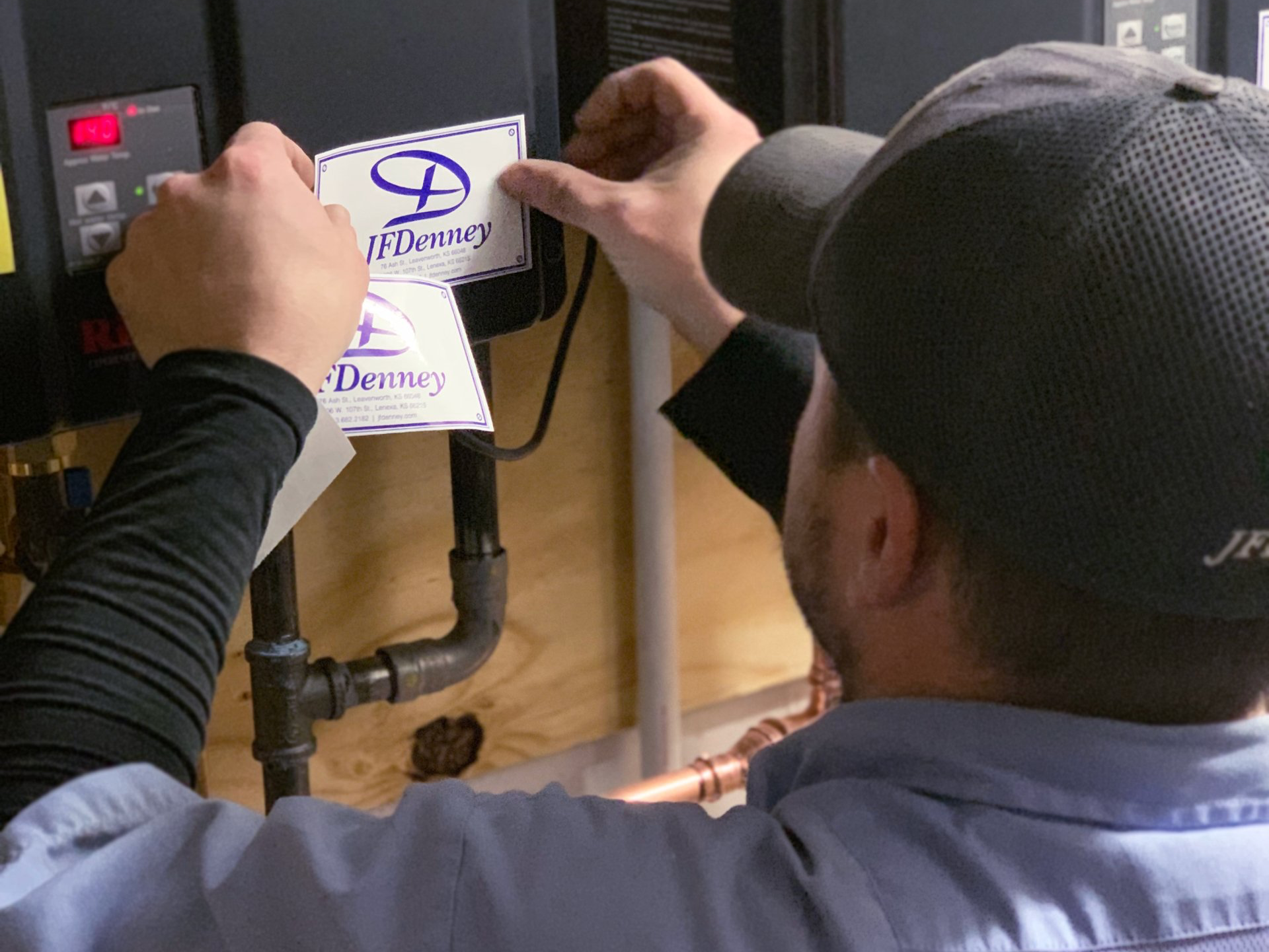
Tankless doesn't mean maintenance-free. Over time, minerals in your water can accumulate inside the heat exchanger. As mineral deposits build up, they can affect the operation of the unit and, if left unaddressed, contribute to damage. That's why periodic flushing, sometimes called descaling, is an important part of tankless water heater maintenance.
Rinnai recommends flushing its tankless water heaters at least once a year. Its published flushing procedure uses 4 gallons of undiluted white vinegar and specifically states that chemical cleaning solutions should not be used.
What Happens During a Flush?
During a professional tankless flush, the water heater is isolated from the home's water supply and a cleaning solution is circulated through the heat exchanger to help remove mineral deposits. The process is more involved than simply draining a traditional tank water heater. Rinnai's published procedure includes shutting down the unit, closing the appropriate water valves, connecting the flushing equipment, circulating the cleaning solution, and properly restarting the system afterward.
For homeowners, the important part is simple:
Your tankless water heater needs periodic attention to remove mineral buildup before it becomes a bigger problem.
How Often Should a Tankless Water Heater Be Flushed?
Rinnai recommends at least annual flushing, but water conditions can affect how frequently maintenance is needed. Rinnai notes that homes with hard water or conditions that cause scale buildup may require more frequent flushing.
That's especially relevant for Kansas City homeowners.
JF Denney offers tankless maintenance and flushing services to help homeowners stay ahead of mineral buildup rather than waiting until a performance problem appears.
Hard Water and Why It Matters With A Tankless Water Heater
Hard water contains minerals that can leave behind scale as water is heated. Because the heat exchanger is where your incoming water is heated, mineral buildup in this area can interfere with the system's performance. Rinnai's installation and service documentation specifically states that hard water must be treated to prevent scale buildup or damage to the heat exchanger. Rinnai also notes that hard-water conditions may require a more frequent flushing schedule. That makes water treatment an important consideration for homeowners with a tankless system!
Can a Water Softener Help?
Treating hard water before it enters the home's plumbing system can help reduce the mineral-related scale that contributes to buildup. For Kansas City homeowners considering a tankless water heater—or homeowners who already have one—this is one reason it's worth looking at the quality of the water throughout the home, rather than focusing only on the water heater itself. JF Denney is also a Kinetico water treatment dealer, offering water-softening solutions designed to address hard-water concerns throughout the home.
A water softener isn't a substitute for tankless maintenance. Even with treated water, your tankless system should still be maintained according to the manufacturer's recommendations. Instead, think of the two as complementary:
Regular flushing removes buildup that has accumulated inside the system, while water treatment can help address the hard-water minerals contributing to that buildup in the first place.
Does a Tankless Water Heater Make Sense for Your Home?
Tankless water heaters can be a good fit for many households, but the right choice depends on your home's hot-water needs, installation requirements, water quality, and maintenance expectations.
A tankless system may make sense if:
- You want to size your system around your household's actual hot-water demand.
- Your home has multiple fixtures that may be used simultaneously.
- You're comfortable keeping up with regular maintenance.
- You're willing to address hard-water concerns.
- You want a system that can be professionally sized for your home's specific needs.
A traditional tank may still make sense if:
- Your household's hot-water needs are relatively straightforward.
- You prefer a more traditional water-heating setup.
- You don't want to plan for periodic tankless flushing and maintenance.
- A tankless installation isn't a practical fit for your home's existing plumbing or gas infrastructure.
There isn't one water-heating solution that works for every household. The best place to start is understanding your home's actual hot-water demand and the conditions your water heater will operate in.
JF Denney can help with tankless water heater installation, maintenance, flushing, and repair throughout the Kansas City area. We can also help you evaluate water-treatment options if hard water is part of the equation. If you're still deciding whether tankless is right for your home, start with our Tankless Pros and Cons blog. Already have a tankless system and need service or maintenance? Contact us for service today!
Why You Should Choose JF Denney
J F Denney, Inc. is a family business founded in 1952. We added HVAC services in 1988 and serve the Kansas City area. Being a family-owned and local company, we are committed to sending our trustworthy technicians to provide top-notch service to our customers and saving them money where it counts the most. Contact J F Denney, Inc. for all of your plumbing and HVAC needs --
We work hard to earn your referral!